We welcome their smiles in a family-oriented environment to awaken, through inclusion and play, the enthusiasm for discovering the world.
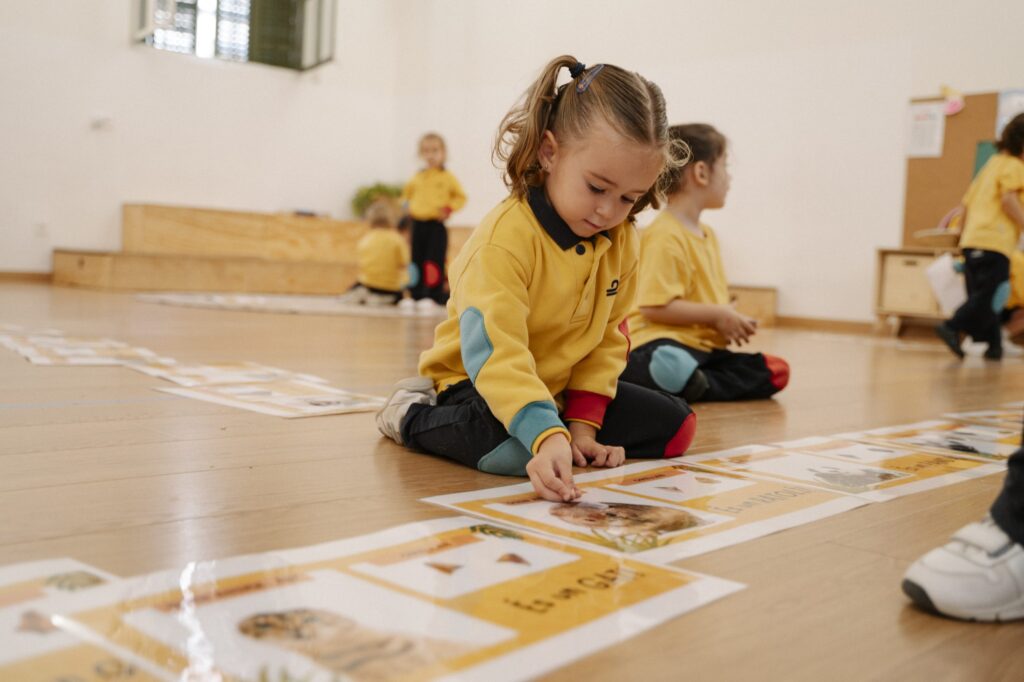
Early childhood education is a very significant stage in children’s development, during which they experience major cognitive changes and develop their language and movement skills. We believe that every child is unique and different, which is why we strive to be creative and flexible in order to enhance all their abilities, always in close collaboration with families.
EARLY STIMULATION
COGNITIVE CHANGES
BEING CREATIVE AND FLEXIBLE
HAPPY CHILDREN
A privileged moment of the day, the first half hour of the morning when the child arrives at school, where we foster the ability to discover and give shape to the new, to listen and internalize, to receive impressions and to express oneself. It is a time for prayer, songs, poetry, stories…
Ludilletres is a creative literacy program focused on the neurological development of children aged 3 to 6. This program places special value on language, considering it a key instrument for oral and written communication, the representation and understanding of reality, the construction of knowledge, and the self-regulation of thought, emotions, and behavior.
The AMCO method is a pedagogical tool for introducing the English language to students, starting as early as I3 (3-year-olds), following a learning process similar to that used for the mother tongue. This allows children to learn the language in a practical and effective way. This methodology is based on the emotional, intellectual, and social development of each student and is inspired by Multiple Intelligences. It offers a wide variety of strategies and activities to work on vocabulary, grammatical structures, and pronunciation, with the goal of providing them with the necessary tools to face the challenges of today’s changing, multicultural, and competitive society.
We open the door to the digital and technological world through Robotics. Using specific tools such as Beebot and Bluebot, and progressively introducing some maker tools, students develop visual-spatial intelligence and logical-mathematical thinking in a playful way. These activities encourage teamwork for problem-solving, allowing students to find solutions in a practical and creative way while developing alternative thinking.
Emotional education is not an isolated activity or just another subject: it is the backbone of a child’s entire development. Between the ages of 0 and 6, the foundations of personality, internal security, and the way of relating to the world are built.
Educating emotions from the first years of life is fundamental for several reasons:
The method we follow is the Ruler method, which allows us to enhance all these aspects of Emotional Intelligence. It helps our students identify, recognize, understand, and label different emotions to subsequently learn how to express and regulate them.
This is how we introduce autonomous learning in our stage. We believe that it is at this moment that we must strengthen the skills that will allow them to develop it throughout the future stages of Primary and Secondary school.
In Early Childhood, we understand autonomous learning as the children’s ability to explore, make decisions, and solve challenges for themselves, always with the attentive and warm guidance of our educators.
We dedicate one afternoon a week to it.
It is a progressive path that respects each child’s pace, which we carry out through:
The benefits provided by this methodology:
It is a didactic-pedagogical project (from ages 3 to 12) based on Multiple Intelligences, which allows for working with mathematics in a useful, practical, and contextualized way, adapting it to the students’ reality.
The program begins working on all mathematical concepts from a very early age, as it understands the need to take advantage of the great learning capacity and adaptability of children’s brains during the first years of life.
Understanding Projects are a methodology that facilitates students’ achievement of understanding by working through Multiple Intelligences (based on Dr. Howard Gardner’s theory). The goal is to help them develop the motor, cognitive, emotional, and relational skills they need to live and coexist in our current world.
These projects are carried out in groups, applying various cooperative work techniques. In this way, personal autonomy, creativity, research, and collaboration are encouraged. At the same time, key attitudes such as responsibility, tolerance, acceptance, and the ability to overcome frustrations are taught. Furthermore, active family participation in the process is promoted.
The Atelier is a space for experimentation, research, and hands-on manipulation. It is inspired by the Reggio Emilia methodology. Both individual and cooperative work are carried out, and different materials are used to facilitate the development of visual-spatial intelligence.
In the Atelier, the child’s voice is heard and their autonomy is strengthened. By allowing the child to freely use their imagination, we are also helping them develop alternative thinking.
With the chess program, we enhance students’ intellectual and creative abilities, favoring the internalization of problem-solving strategies. We consider chess to be an ideal setting for contributing to the construction of children’s inner worlds, as it helps them develop key skills such as planning, improving attention, making decisions, and exercising hypothetical, intuitive, and abstract thinking. Furthermore, it is an excellent tool for educating in values such as respect, acceptance of rules, discipline, tenacity, learning from mistakes, and managing success and frustration (knowing how to win and how to lose).
It is very important to take advantage of the incredible learning capacity that boys and girls have during the first six years of life. For this reason, our Early Stimulation program aims to promote good neurological organization, capable of preventing possible difficulties in future learning.
To do this, we follow Dr. Glenn Doman’s method, which focuses on harnessing the innate desire to learn that every child possesses at these early ages, when their brain is most capable and receptive. In practice, we apply specific tools from this method, such as encyclopedic bits, math and reading bits, the Basic Development Program (BDP), and various listening sessions.
This program is fully established in the Early Childhood Education stage, and the excellent results achieved highlight its continuity.
We use cookies to improve your experience on our site. By using our site, you consent to cookies.
Manage your cookie preferences below:
Essential cookies enable basic functions and are necessary for the proper function of the website.
These cookies are needed for adding comments on this website.
These cookies are used for managing login functionality on this website.
Statistics cookies collect information anonymously. This information helps us understand how visitors use our website.
Google Analytics is a powerful tool that tracks and analyzes website traffic for informed marketing decisions.
Service URL: policies.google.com (opens in a new window)
SourceBuster is used by WooCommerce for order attribution based on user source.
You can find more information in our Cookie Policy and Política de Privacitat.


